
 English
 Español
 Русский
 Français
 Português
 العربية
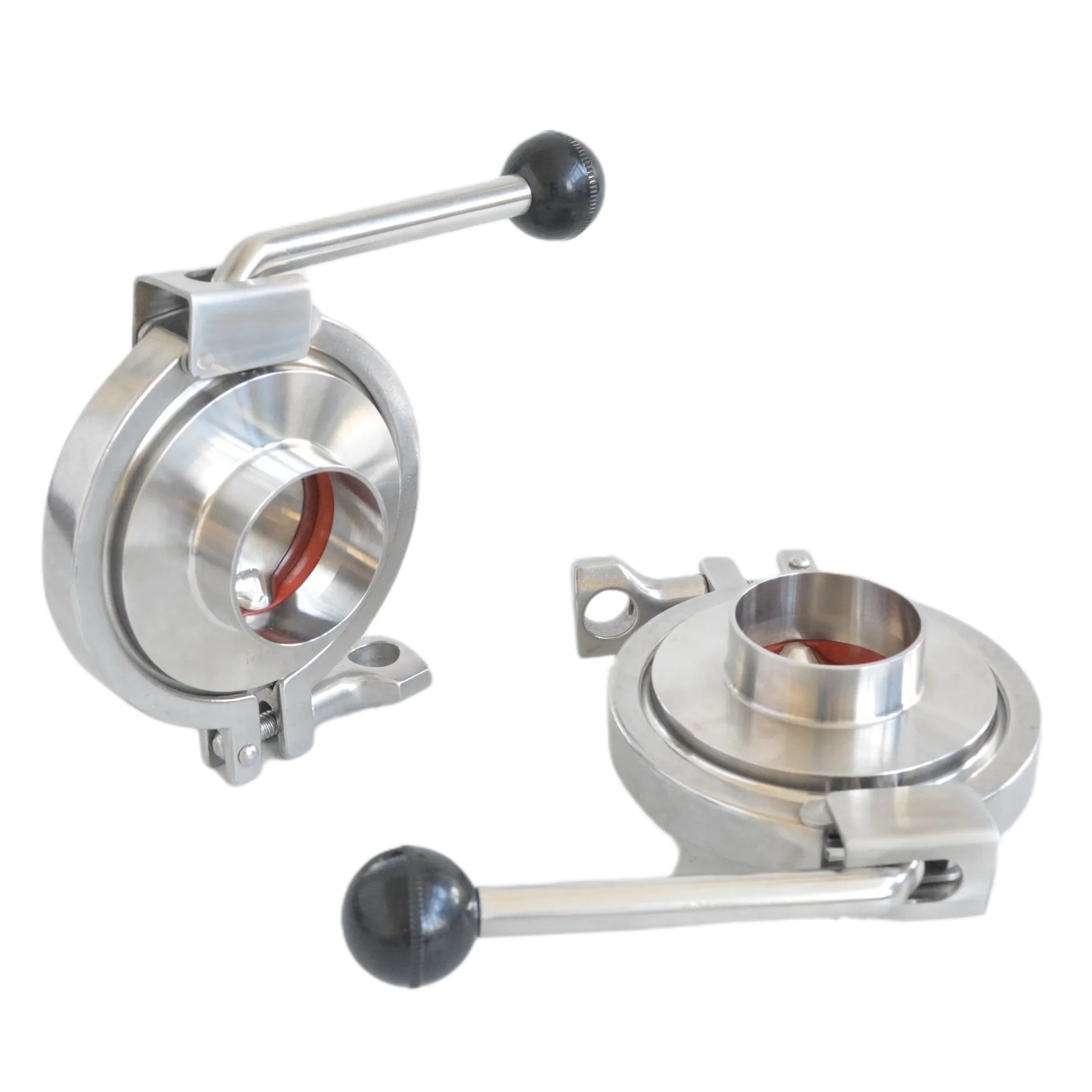
Stainless steel sanitary butterfly valves are specifically designed for food, pharmaceutical, bioengineering, and other environments requiring high cleanliness. Their core features are primarily reflected in four aspects: structural design, material processing, ease of cleaning, and operational performance. The following is a detailed analysis:
Stainless steel sanitary butterfly valves are specifically designed for food, pharmaceutical, bioengineering, and other applications requiring
high cleanliness. Their core features are primarily reflected in four aspects: structural design, material processing, ease of cleaning, and
operational performance. Here is a detailed analysis:
1. Material and Surface Treatment
Pure Material: Typically made of 304 or 316L stainless steel (low carbon content, strong resistance to intergranular corrosion). Parts in contact with
the media may use alloys with even higher corrosion resistance.
Precision Polishing: All internal surfaces in contact with the media (valve body interior, valve plate surface) are mechanically or electrochemically
polished, achieving a roughness of Ra≤0.4μm or even Ra≤0.2μm. This effectively prevents material residue and microbial growth, meeting GMP
(Good Manufacturing Practice) and FDA (Food and Drug Administration) standards.
2. Sanitary Structural Design
No Dead Corners: The valve body structure design avoids recesses, gaps, or dead corners, ensuring complete drainage or cleaning of the media
during flow.
Quick Disassembly and Assembly: Common connection methods include clamp quick-connect, but welding or threaded connections are also
available. The clamp design allows for quick disassembly and cleaning without special tools, facilitating CIP (Clean-in-Place) and SIP
(Sterilization-in-Place) processes.
Leak-Proof Sealing: Valves use food-grade EPDM (Ethylene Propylene Diene Monomer), VMQ (Silicone Rubber), or FPM (Fluororubber) seats.
These materials are heat-resistant (withstanding sterilization temperatures), acid and alkali resistant, and provide excellent sealing to prevent
external contaminants from entering.
3. Operation and Regulation Characteristics
Compact Size and Light Weight: Compared to ball valves or gate valves of the same diameter, butterfly valves have a compact structure, occupy
less space, and are easy to install in areas with dense clean piping.
Flow Regulation: Butterfly valves can be used for full open and full close shut-off, and also have a certain flow regulation function
(by changing the valve plate opening angle). However, in sanitary applications, for high-precision regulation, a positioner is usually used in
conjunction with the valve.
Low torque, easy operation: Quick opening and closing (usually only 90-degree rotation required), low operating torque, and can be equipped
with a handle (with positioning), turbine box, or pneumatic/electric actuator for automated control.
4. Application Advantages and Limitations
Advantages:
Large flow capacity: Low flow resistance coefficient, relatively low pressure loss.
High cleanliness: Particularly suitable for conveying milk, beer, juice, pharmaceuticals, purified water, etc.
Moderate cost: In sanitary pipelines with larger diameters (e.g., DN50 and above), butterfly valves are generally more cost-effective than sanitary
ball valves of the same diameter.
Limitations:
Not suitable for high-viscosity or particulate media: The valve plate may exert a shearing effect on the media during opening/closing, and
particles can easily become trapped between the valve plate and the sealing seat, leading to poor sealing.
Sealing pair durability: Rubber valve seats are consumable parts and require periodic replacement under long-term high temperature or
corrosive media conditions.
Summary: The greatest advantage of stainless steel sanitary butterfly valves is that they achieve easy operation and economical pipeline
control while meeting high cleanliness standards. It is particularly suitable for low-pressure, large-diameter applications where frequent pipeline
cleaning is required and strict requirements are placed on residue control.
继续阅读
-
- Butterfly valves
食品加工厂该如何选对卫生级蝶阀?
-
- Butterfly valves
卫生级蝶阀有哪些常见连接方式?
-
- Butterfly valves
卫生级蝶阀的主要用途有哪些?
-
- Butterfly valves
蝶阀终极指南:为什么不锈钢阀门是最佳选择