 English
 简体中文
简体中文
 Español
 Русский
 Português
 العربية
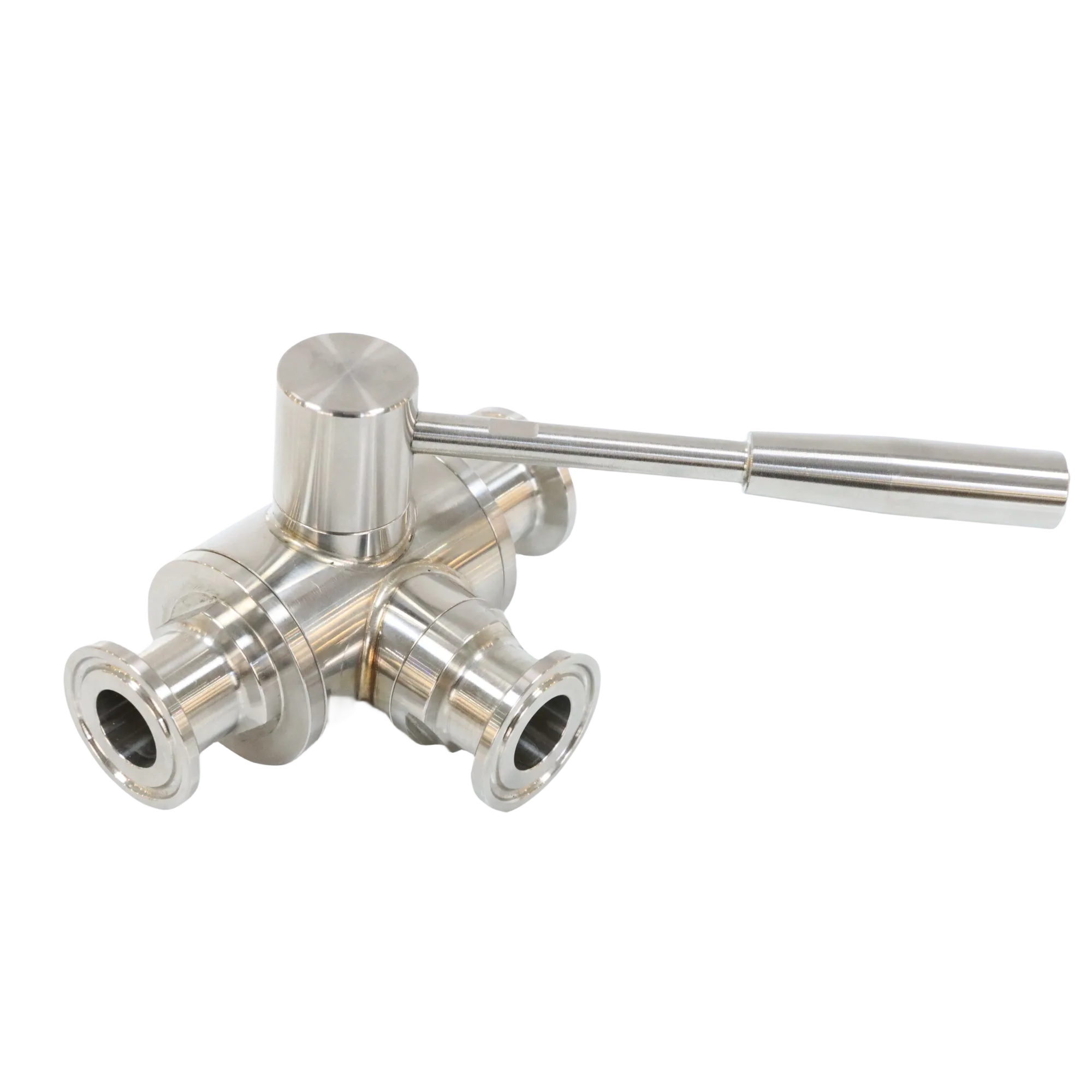
Différence entre les configurations en L et en T des vannes à boisseau sphérique trois voies sanitaires en acier inoxydable
Dans les vannes à boisseau sphérique trois voies sanitaires en acier inoxydable, la principale différence entre les types L et T réside dans la forme du canal d'écoulement de la
Dans les vannes à boisseau sphérique trois voies sanitaires en acier inoxydable, la principale différence entre les types L et T réside dans la forme du canal d'écoulement de la
bille et la fonction de contrôle de direction du fluide qui en résulte.
En résumé : le type T fonctionne principalement comme vanne de mélange/répartition (permettant l'interconnexion simultanée des trois orifices), tandis que le type L
fonctionne principalement comme vanne de commutation/redirection (ne reliant généralement que deux orifices).
Voici une analyse comparative détaillée :
1. Forme et structure du canal d'écoulement
Type T (trois voies, canal en forme de T)
Forme : Le canal interne de la bille est en forme de T. Les trois orifices (A, B, P) sont interconnectés à l'intérieur de la bille
(ils partagent un point d'intersection commun).
Caractéristiques : Permet de connecter simultanément deux des trois voies, ou les trois orifices à la fois.
Type L (deux voies, canal en forme de L)
Forme : Le canal interne de la bille est en forme de L (angle à 90 degrés).
Caractéristiques : Le canal est coudé à l'intérieur de la bille. En général, seules deux voies adjacentes peuvent être connectées simultanément
(par ex. entrée et sortie gauche, ou entrée et sortie droite), le troisième orifice étant fermé. Il est impossible de connecter les trois orifices simultanément,
ni de relier directement deux orifices alignés (par ex. orifices gauche et droit).
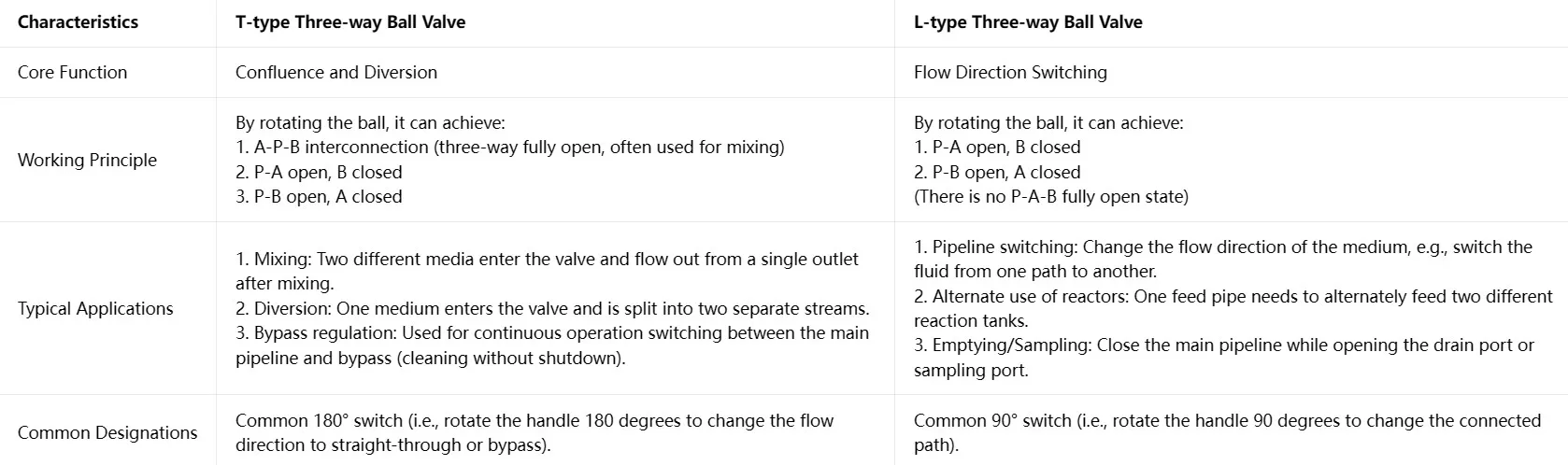
2. Fonctions et scénarios d'application
3. Méthode d'identification visuelle
Sans consulter la plaque signalétique, vous pouvez observer la poignée et les marquages sur le corps de vanne pour déterminer le type :
Observer la forme ou les marquages de la poignée :
De nombreuses vannes sanitaires comportent un schéma du circuit gravé sur la poignée.
Si le schéma montre trois orifices avec des lignes en « T » à l'intérieur, il s'agit d'un type T.
Si le schéma montre trois orifices avec des lignes en « L » à l'intérieur, ou si seulement deux orifices sont reliés par une ligne, il s'agit d'un type L.
Observer le dessous du corps de vanne (s'il s'agit d'une pièce moulée) :
Certains corps de vanne moulés portent la mention « T » ou « L » sur le dessous.
Résumé
Choisir le type T : Lorsque vous devez mélanger deux produits, ou maintenir un débit vers les deux sorties simultanément (ou diviser une entrée en deux sorties),
et autoriser un écoulement à trois voies.
Choisir le type L : Lorsque vous devez changer la direction du fluide (par ex. basculer d'une cuve à une autre) et ne souhaitez pas un écoulement à trois voies
simultané (pour éviter la contamination croisée ou le reflux).
Il convient également de noter que, s'agissant de vannes de qualité sanitaire (utilisées dans les industries agroalimentaire, pharmaceutique, etc.), les modèles de type L comme de type T
utilisent généralement des raccords Tri-Clamp pour la connexion, et le matériau interne est de l'acier inoxydable 316L, poli avec précision pour
garantir l'absence de zones mortes et faciliter le nettoyage.