 简体中文
简体中文
 Español
 Русский
 Français
 Português
 العربية
- Ball valves
- 2 min read
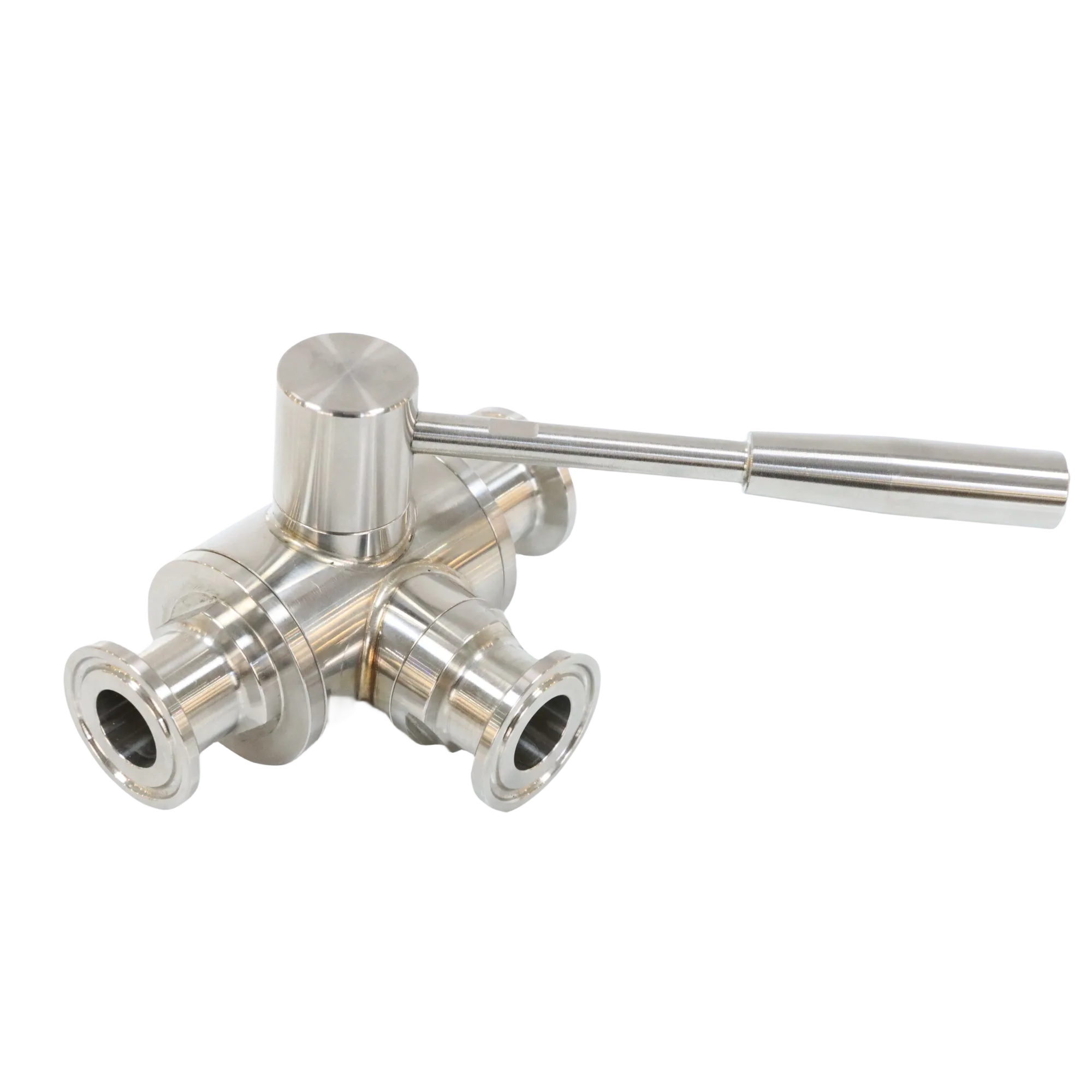
Difference between L-type and T-type configurations in stainless steel sanitary three-way ball valves
In stainless steel sanitary three-way ball valves, the main difference between L-type and T-type valves lies in the flow channel shape of the
In stainless steel sanitary three-way ball valves, the main difference between L-type and T-type valves lies in the flow channel shape of the
valve core and the resulting fluid flow direction control function.
Simply put: the T-type mainly functions as a mixing/diverting valve (allowing simultaneous interoperation of all three ports), while the L-type
mainly functions as a switching/redirecting valve (usually connecting only two ports).
The following is a detailed comparative analysis:
1. Flow Channel Shape and Structure
T-type (Three-way, T-shaped flow channel)
Shape: The internal channel of the valve core is T-shaped. The three ports (A, B, P) are interconnected within the valve core
(they share a common intersection point).
Features: Allows any two of the three channels to be connected simultaneously, or all three ports to be connected.
L-type (Two-way, L-shaped flow channel)
Shape: The internal channel of the valve core is L-shaped (90-degree angle).
Features: The flow channel is curved within the valve core. Typically, only two adjacent channels can be connected simultaneously
(e.g., inlet and left outlet, or inlet and right outlet), and the third port is closed. It cannot allow all three ports to be connected simultaneously,
nor can it allow two straight ports (e.g., left and right ports) to be directly connected.
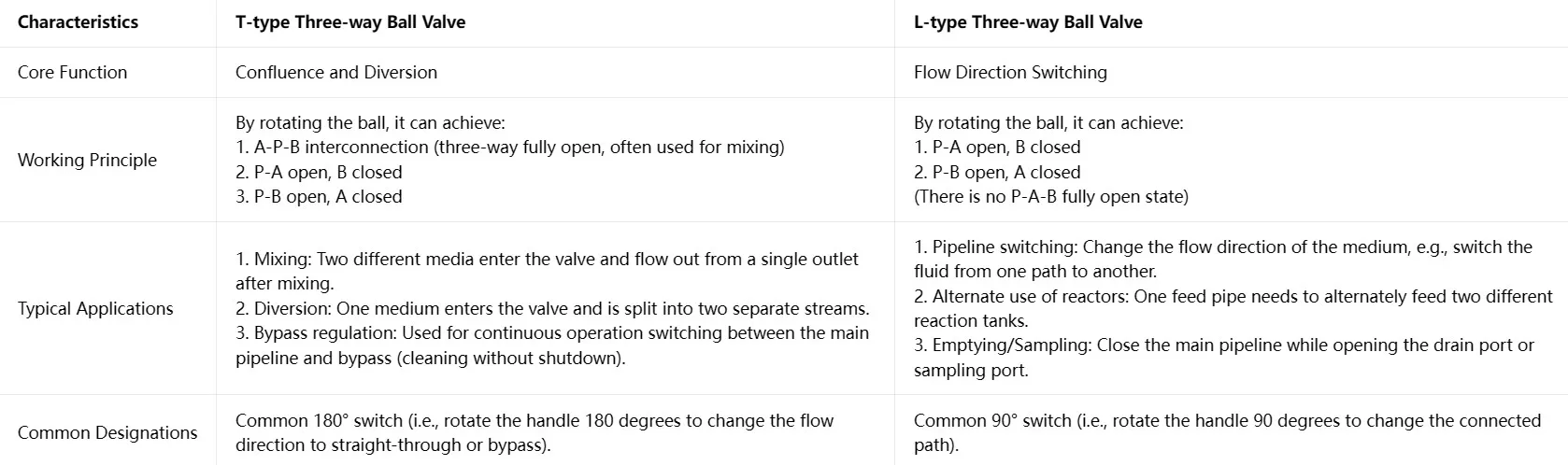
2. Functions and Application Scenarios
3. Visual Judgment Method
If you don't need to look at the nameplate, you can observe the handle and markings on the valve body to determine its type:
Observe the handle shape or markings:
Many sanitary valves have a flow path diagram engraved on the handle.
If the diagram on the handle shows three ports with "T" shaped lines inside, it's a T-type.
If the diagram on the handle shows three ports with "L" shaped lines inside, or only two ports are connected by a line, it's an L-type.
Observe the bottom of the valve body (if it's a casting):
Some cast valve bodies will have "T" or "L" marked on the bottom.
Summary
Choose T-type: When you need to mix two materials, or need to maintain fluid at both outlets simultaneously (or one inlet split into two outlets),
and allow three-way flow.
Choose L-type: When you need to change the fluid direction (e.g., switching from one tank to another) and do not want three-way flow
simultaneously (to avoid cross-contamination or backflow).
It is also worth noting that, as they are sanitary grade (used in the food, pharmaceutical and other industries), both L-type and T-type models
typically use quick-release clamps for connection, and the internal material is 316L stainless steel, which has undergone precision polishing to
ensure no dead corners and easy cleaning.
Read next
-
- Ball valves
- 5 min read
Differences Between Ball Valves And Plug Valves
-
- Ball valves
- 4 min read
How to select the right stainless steel ball valve for a chemical process
-
- Ball valves
- 4 min read
What is the working principle of a stainless steel ball valve?
-