
 English
 简体中文
简体中文
 Español
 Français
 Português
 العربية
- Diaphragm valves
- 3 мин чтения
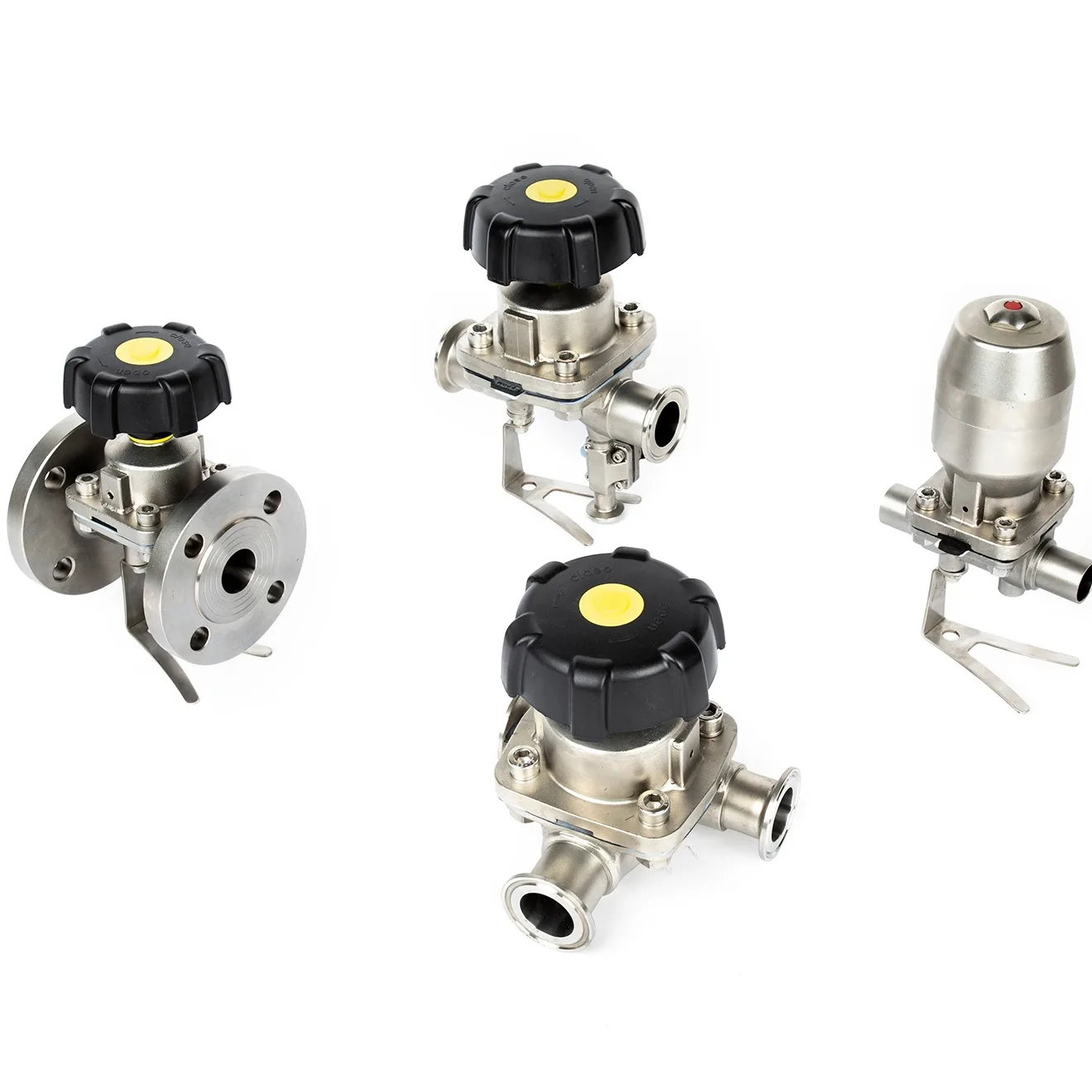
What are the main advantages of using sanitary stainless steel diaphragm valves in process control?
The core advantage of using sanitary stainless steel diaphragm valves in process control lies in integrating unparalleled cleanliness, reliable safety,
The core advantage of using sanitary stainless steel diaphragm valves in process control lies in integrating unparalleled cleanliness, reliable safety,
and high-efficiency process control, making them the preferred choice for industries with extremely high requirements for hygiene and cleanliness.
Advantage 1: Unparalleled Cleanliness, Eliminating Contamination and Residue
Complete media isolation ensures purity: The diaphragm, located between the valve body and valve cover, forms a physical barrier, completely
isolating the fluid inside the pipeline from external mechanical components such as the valve stem and actuator. This fundamentally eliminates
the risk of external contaminants (such as lubricating oil and metal particles) entering the media, while ensuring that the operating mechanism
is not corroded by the media.
"Zero" dead angle structure eliminates residual risks: The inner wall of the valve body is smooth and flat, employing a self-draining structure
design without dead angles or pits, and the surface is precision polished (roughness can reach Ra 0.4μm or even lower). This allows the media to
be completely drained, preventing the formation of any residual dead angles inside the valve, thereby effectively preventing bacterial growth and
cross-contamination.
Superior sealing performance ensures "zero leakage": The diaphragm and valve seat form a tight seal, ensuring bidirectional zero leakage.
Equipped with high-performance diaphragms such as EPDM and PTFE (EPDM can withstand continuous steam operation up to 150°C), ensuring
absolute sealing even under harsh conditions such as high temperatures and corrosive media.
Advantage 2: Safe and Durable Structure for Efficient Maintenance
Superior Materials, Adaptable to Harsh Environments: The valve body widely uses 316/316L stainless steel, possessing excellent corrosion
resistance and ensuring long-term stable operation even under high temperatures and pressures, especially resistant to corrosion and steam
sterilization. The all-stainless steel drive section also meets the highest requirements for aseptic production conditions.
Rugged Structure and Reliable Design: The diaphragm isolates the actuator from the piping system, reducing wear on moving parts. Compared to
traditional valves, its structure is simpler and more compact. After long-term use, diaphragm wear can be quickly replaced, significantly reducing
maintenance costs.
Advantage 3: Excellent Process Integration and Automation
Perfectly Adaptable to CIP/SIP Processes: Highly adaptable to CIP (Cleaning in Line) and SIP (Sterilization in Line) processes, its smooth inner wall
and dead-angle-free design ensure full contact between cleaning fluid and steam on all internal surfaces. The reduced thermal mass resulting
from optimized design also effectively shortens sterilization time and improves system productivity.
Process control precision and automation: The diaphragm's motion characteristics allow for sensitive flow regulation (especially between 15° and
70° opening), and with the addition of pneumatic or electric actuators, the valve can be easily integrated into automated production lines.
Compared to traditional throttle valves, gate valves, or stop valves, diaphragm valves can more tightly "hold" particulate matter in pipelines,
performing superiorly in applications with suspended solids or high-viscosity fluids.
Compliance with international standards and regulations: Designed and manufactured in compliance with numerous stringent international
standards such as FDA, EHEDG, 3-A, ASME BPE, and ISO, providing direct evidence of meeting GMP (Good Manufacturing Practice) and other
industry-specific hygiene requirements.
Summary: Sanitary stainless steel diaphragm valves, through their unique design, combine four core advantages: hygiene, safety, reliability, and
high efficiency.
Читайте далее
-
- Diaphragm valves
- 4 мин чтения
What is the difference between a diaphragm valve and a globe valve?
-
- Diaphragm valves
- 3 мин чтения
What is the working principle of a sanitary stainless steel diaphragm valve?
-
- Diaphragm valves
- 3 мин чтения
How to choose the right diaphragm valve for water treatment
-
- Diaphragm valves
- 5 мин чтения
How To Select Suitable Membrane Materials To Ensure Their Chemical Compatibility