
 English
 简体中文
简体中文
 Español
 Français
 Português
 العربية
- Diaphragm valves
- 3 мин чтения
What is the working principle of a sanitary stainless steel diaphragm valve?
The unique working principle of sanitary stainless steel diaphragm valves is key to their high cleanliness and reliable sealing.
The unique working principle of sanitary stainless steel diaphragm valves is key to their high cleanliness and reliable sealing.
At its core is a simple concept of "isolation": a flexible diaphragm completely isolates the valve's operating components from the fluid in the
pipeline, and the flow of fluid is controlled by tightening or loosening this diaphragm.
Valve Anatomy: Two Core Components
A sanitary diaphragm valve mainly consists of two parts:
Upper Actuator: This is the valve's "brain" and "muscles," responsible for providing power. It can be a manually operated handwheel or handle,
or an automated pneumatic or electric actuator.
Lower Valve Body Flow Channel: This is the "pipeline" through which the medium flows. Its inner wall is typically precision-polished, smooth and
without dead corners, forming the basis for achieving a clean environment.
Core Component: The Diaphragm
The key component connecting the actuator and the valve body is the diaphragm. It is usually made of elastic, corrosion-resistant materials such
as EPDM (ethylene propylene diene monomer) and PTFE (polytetrafluoroethylene), which meet FDA requirements. The diaphragm physically
isolates the upper actuator from the lower media flow channel.
Operating Principle: Opening and Closing Actions
The operating principle can be summarized as "press down to close, lift up to open." The entire process is achieved by the up-and-down
movement of the valve stem, changing the position of the driving device (such as the valve disc or pressure pad), causing the diaphragm to bend.
Generally, this includes the following two scenarios:
Closing Process: When the valve needs to be closed, the actuator drives the valve stem downwards. The valve stem pushes down the connected
valve disc or "pressure pad," forcing the flexible diaphragm to bend downwards. The diaphragm is tightly pressed against the "valve seat"
(an arc-shaped weir structure) in the middle of the valve body, forming a tight seal, thereby cutting off the fluid passage and achieving closure.
Opening Process: When the valve needs to be opened, the driving device drives the valve stem upwards. The valve stem rises, releasing the
pressure on the diaphragm. Due to its elasticity, the diaphragm rebounds upwards, reopening the fluid passage.
Opening Process: When opening is required, the driving device drives the valve stem upwards. The valve stem rises, releasing the pressure on the
diaphragm. Due to its own elasticity, the diaphragm rebounds upwards, reopening the fluid passage.
Drive type: Valve operation mode
Based on the needs of production process automation, diaphragm valves have the following mainstream drive methods, all of which aim to
precisely control the movement of the valve stem.
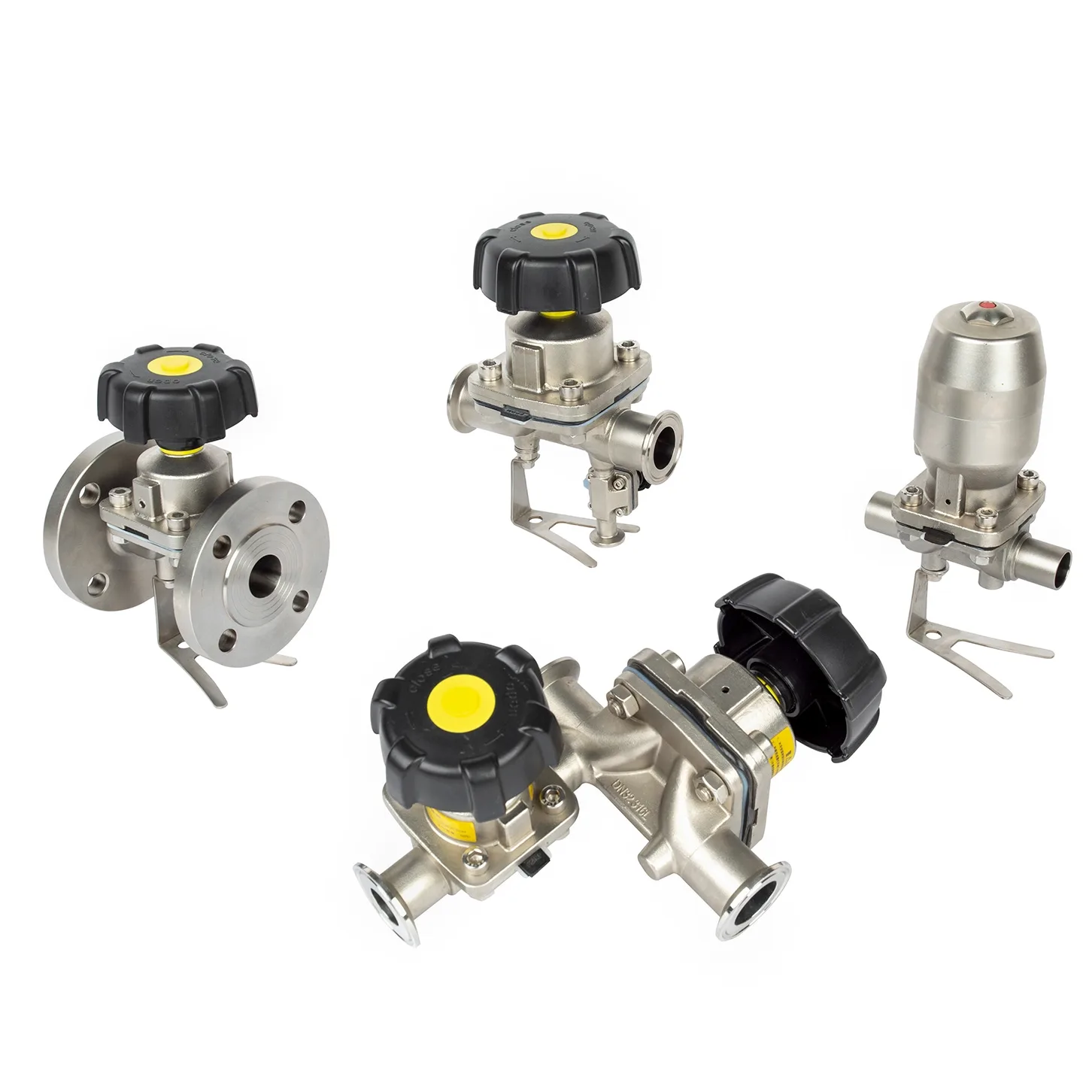
Product Diversity
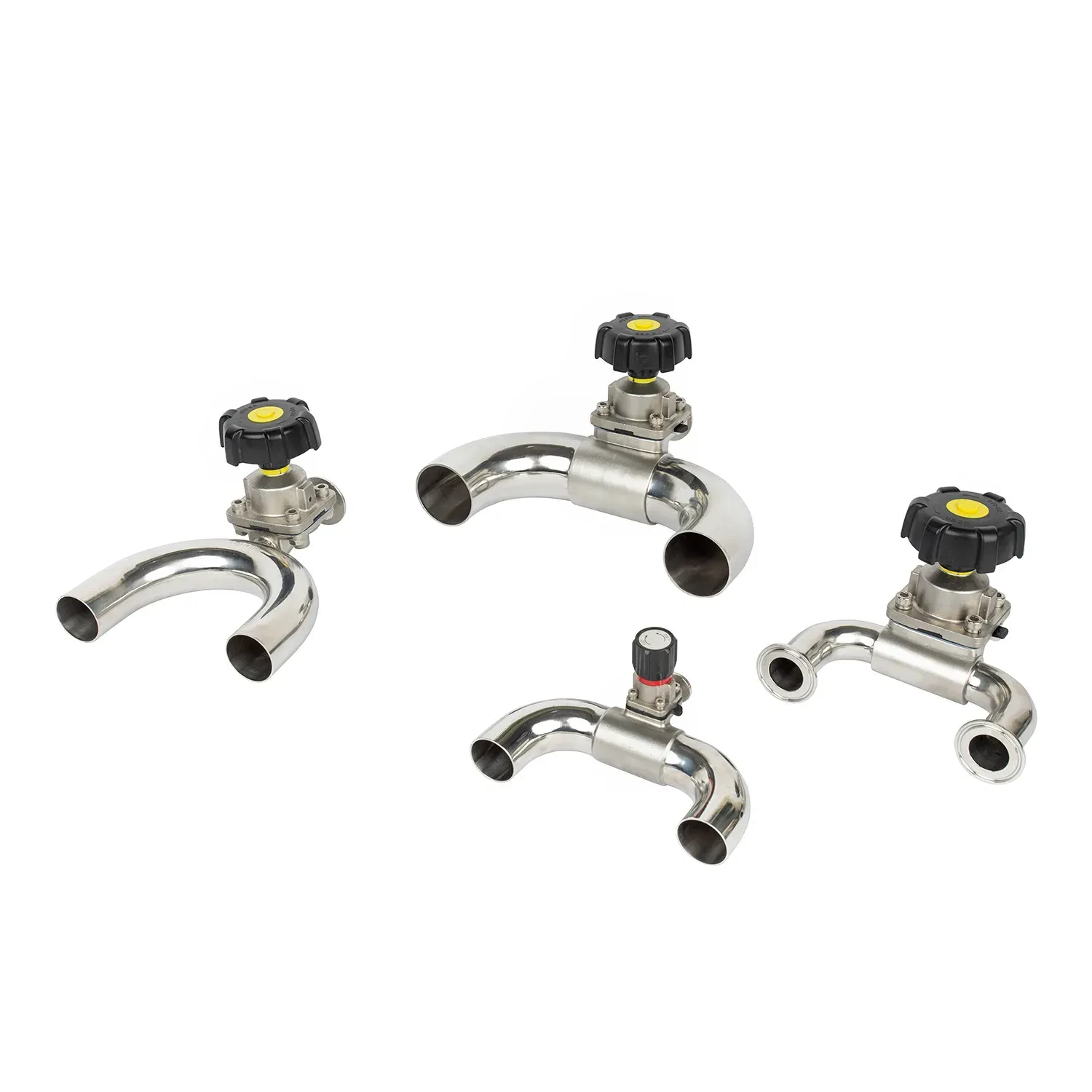
Sanitary diaphragm valves are available in various specifications and variations to meet different application requirements. For example:
Two-way valves: The most common type, used for simple opening and closing in pipelines.
Multi-way valves: Such as U-shaped three-way diaphragm valves, used to distribute or mix the flow directions of different fluids.
Bottom valves: Specifically designed for installation at the bottom of tanks or containers to achieve complete emptying and eliminate dead zones.
Sanitary stainless steel diaphragm valves completely isolate the drive mechanism from the medium through a resilient diaphragm, achieving
ultimate clean sealing and reliable fluid control, making them an ideal solution for sanitary process control.
Читайте далее
-
- Diaphragm valves
- 4 мин чтения
What is the difference between a diaphragm valve and a globe valve?
-
- Diaphragm valves
- 3 мин чтения
What are the main advantages of using sanitary stainless steel diaphragm valves in process control?
-
- Diaphragm valves
- 3 мин чтения
How to choose the right diaphragm valve for water treatment
-
- Diaphragm valves
- 5 мин чтения
How To Select Suitable Membrane Materials To Ensure Their Chemical Compatibility